Posts

Showing posts with the label read

Six fundamental elements that should form the backbone of your school's reading strategy

Image
Many schools complain that their literacy programmes are not yielding results although they are working very hard. Perhaps there are critical gaps in your approach.   Does your school's reading strategy encompass these SIX fundamental elements? SIX FUNDAMENTAL ELEMENTS TO GIVE YOUR SCHOOL'S READING STRATEGY A SOLID FOUNDATION 1. Understand deeply why learners need to be excellent readers. We should know by now that a child who reads fluently, with comprehension at or above his age cohort, has mastered the skills to learn better and faster. Poor readers are doomed . If there is any doubt in your mind that this understanding of the power of reading is not fully understood by all the staff members, you will need to build this mindset aggressively. Run coaching sessions on reading while you action the reading strategies as discussed below. 2. Make the Needu National Report 2012: Summary, one of the "handbooks" for the entire teaching staff. Most po...

Teachers and Principals have to read to stay informed.

Image
Prof. Jonathan Jansen signing books with Square Hill Primary School learners waiting to chat to him. We say children have to read to help them learn faster, but how many of our principals and teachers are reading? If you speak to teachers, principals and even district officials, it becomes evident that many of those directly involved in education seldom make time to read. Reading feeds the soul and the mind One inherent danger in not reading for leisure or reading literature in your own industry means you are stunting your own personal and professional growth. Leisure reading is a pleasurable activity and a stress reliever. Reading takes our minds away from all the pressures and allows us to enter the world of others at no cost. On the flip side, professionals should read to keep their minds fresh. Reading helps them build their knowledge which will come in handy during their work as well. How are we going to stay abreast of all the new knowledge that is created at breakneck speed if w...

Building strong literacy skills in Foundation Phase: insights drawn from academic article by #Elizabeth Pretorius

Image
Grade R Learners at Steenberg a Primary School #ElizabethPretorius (UNISA) wrote a research article on a South African literacy intervention programme that she conducted at a Gauteng township school in 2010. I found this fascinating research article on #NicSpaull's blog. The link for the article, "Supporting transition or playing catch-up in Grade 4? Implications for standards in education and training." is on Nick's blog. Do pop in there and download the article. I want to highlight FIVE key insights that I have gleaned from this research conducted by Elizabeth Pretorius. 1 . Schools can make a difference if the classroom is a literacy hub. I like the realistic spin that schools can help to bridge the gap of children's literacy deficits IF we have a highly-focused, sustained literacy approach at the foundation level. Other research has showed this, but we don't really have a large body of research on intervention case studies like this in Sout...

Classroom libraries and other school business at Harmony Primary School

Image
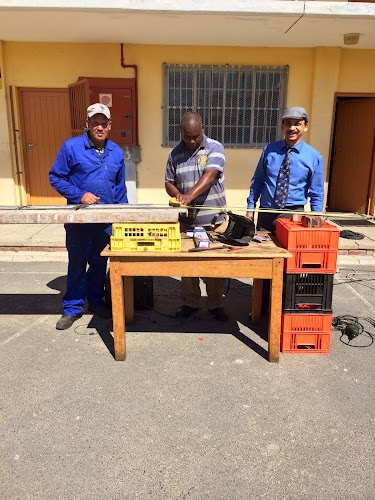
Ernst Esau (far right) standing with the welder and the school caretaker Impromptu visit to Harmony Primary School at the request of the Principal I visited Harmony Primary School today at the request of the principal, Ernst Esau. We had spoken on the telephone earlier and our conversation centred on Ernst's frustrations with their "plankie" school building and the high maintenance bill the school had to foot. Ernst has also been watching the renovations at other schools and our apparent disregard for their plight dominated our discussion. I listened patiently and offered advice as best I could. Then Ernst said, if I had time, could I please pop in at the school because he had a few documents he needed to process. I know our principals fairly well by now and I know the narratives behind such requests. It is the end of term one and the pace at schools is demanding. Throw in budgetary constraints, social issues, teacher fatigue and systems demands, and you know that you ha...

Social work services should be flipped to be in line with their core purpose

Image
Social workers have an educational role to play Social workers, like teachers, are supposed to be spearheading social change? Social workers working closely with our schools have the ideal platform to intervene proactively by integrating their services into the daily programme of school life. Let me explain where I am heading with this discussion by presenting a brief profile of the families and children who probably constitute 80% of a social worker's case load.   The sector that depends heavily on the support and intervention services of social workers is the poor, broken families. This group usually has multiple socio-economic and psychological problems that cause their lives to be unbearable. Because they do not have the knowledge nor the money to escape from this suffering, their future generations get stuck in this cycle as well.   If we want to help lift communities out of their poverty trap, the key driver is access to quality education. Research supports this view that e...