Posts

Showing posts with the label The Classroom

Reviewing the Reading 40 Books per Learner Campaign in the Lavender Hill-Steenberg Schools .

Image
For the past three years, we have been actively promoting independent reading at our schools.  In 2013, Colleen Diedericks, then the Foundation Phase Subject Adviser, and I implemented a Literacy Improvement Strategy in our circuit. The Literacy Strategy was designed to meet three objectives. THREE OBJECTIVES OF THE LITERACY STRATEGY Firstly, we wanted schools to explore and interact with research that sought to explain how schools themselves entrench low literacy levels because of organizational and classroom teaching problems. Secondly, we aimed to help schools expand their peer networks so that they could have access to more resources and support. Thirdly, we believed that a corporate book reading campaign would help to galvanize school's literacy improvement programmes and energise them to lift the reading levels at their school. That is how the Reading 40 Books Per Learner Campaign came into being. Let me give you an overview of the build up to launching the Re...

Protect teaching time at all costs.

Image
Schools that do not protect teaching time have the most problems. This is a fact.  There are many contextual issues that play a role, but class teaching time is the teacher's domain.  Before we look at the external issues, we need to ensure that the classroom environment is structured in favour of good, solid teaching and learning. There are certain fundamentals that must be in place when we talk about protecting teaching time.  Firstly, teachers must be in their classes on time.  If teachers are habitually late or absent from their classes, children will take over the space. This is not rocket science. There will be a breakdown in discipline because the children have been allowed to  run wild.  If this situation happens, then the teacher must take responsibility for the chaos and the waste of teaching and learning time. Secondly, there must be a deliberate intention to devote the lesson time to  disciplined teaching and learning...

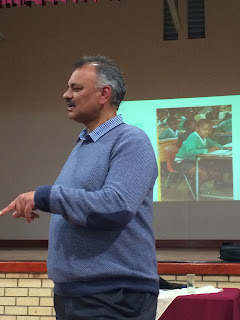
"Every child can succeed if we turn around our schools through deep change" - Eugene Daniels

Image
Today Eugene Daniels, gave a powerful talk at our SMT forum about the deep change we need if we want to turn schools around. Eugene Daniels's message is clear: Let's teach beyond teaching to targets. Let's teach to each child's dream".  If children do not succeed, adults have to take responsibility for the children's failure. This is a 360 degree turn, flipping traditional thinking that blames the child for not achieving. Eugene Daniels having a meaningful conversation with our school leadership teams You must experience Eugene Daniels to benefit from his evidence-based talk about deep change. Besides drawing on literature, Eugene's shared how he is implementing the model of deep change and he gave us a few practical tips on how schools can deepen their own transformation.  These are a few of the insights that I gleaned from the talk. We must learn to do things differently. We should move away from doing more of the same. If we don't l...

World Book Day 2015 is one of the highlights on primary school calendars

Image
Kleinberg Primary School Learners on World Book Day (Photo: Nadia) World Book Day is one of the highlights on the calendars of our primary schools. It doesn't matter which primary school you visited last Thursday, 23 April, you would have experienced the joys of schools celebrating the reading of books.  In fact,  all the schools form part of a spontaneous inter-school Book Gala Festival event here. The colourful flamboyancy around World Book Day makes the event irresistible. It is one of those school events that most parents become involved in. Each school organizes their own World Book Day festival based on the central theme: Celebrating the importance of reading.  The entertainment line up includes open-air poetry recitals, book reading, musicals and drama skits. Children dress up as their favourite storybook character and teachers join in on the fun as well.   Interestingly, the children always choose to impersonate the main character in the stor...

How to build a homework culture at your school.

Image
Homework blues When poor schools build a homework culture at their school s, they add another effective learning strategy to help improve and strengthen their children's learning abilities.  We know that all children can learn. The challenge is to win the parents over to help the school create these learning opportunities at home. Given all the parents' issues, they may see the homework as a minor matter. Schools need to become advertising agencies, promoting homework creatively until parents become the advocates of homework themselves. Think of the Coke adverts. Which person doesn't recognize the Coke slogan, the Coke colours and other Coke branding?  Here are four benefits that regular homework will have: Parents and their children will have a structured activity to complete together. A homework routine will help to establish a culture of discipline for both the parent and the child. The child will develop study habits. Over time, the parent wi...

Homework should not be an option for schools in poor communities.

Image
The issue of giving homework at primary schools is a hot potato. Generally, schools believe that homework is an important learning activity. This is where the similarity ends. At wealthier schools,  homework is an embedded whole school practice. At the other end of the spectrum where we find poor schools, homework as a school-wide learning activity is practically non-existent. Why is this so? Homework culture at poor schools Teachers at poor schools tell me that giving homework is a waste of time. They say the homework is never done because the parents are not interested. Teachers will list other issues like the following:  parents work long hours, the caregivers of many of their children are grandparents or parents are unable to help children with their homework. Teachers respond  by not setting homework assignments at all. Sadly, this decision is not shared with parents and in the main, parents do not question this either. Homework culture at wealthy schoo...

Trade secrets for teachers who want high performing classes.

Image
A welcoming tone is set creatively by Teacher Karen Hamman at St Mary's R.C. Primary School Round table discussions with teachers about their trade secrets. Presently, I am having interesting discussions with schools and SMTs about the magic happening in their high performing classes.  The first school I engaged was Sibelius High School that is situated in the Steenberg area. We wanted to know how certain teachers like Mr Reading, the Mathematical Literacy subject teacher, for example was able to achieve 100% pass rate and good quality passes in the 2014 NSC 2014 examination. What were the successful teachers doing differently in their classrooms? Here are 10 trade secrets of how to transform your class into a high performing class, straight form the mouths of successful teachers at this school. Ten teaching trade secrets  1.   "It's all about your attitude. You have to change your personality before you go into the class. First prepare yourself and the...

Six fundamental elements that should form the backbone of your school's reading strategy

Image
Many schools complain that their literacy programmes are not yielding results although they are working very hard. Perhaps there are critical gaps in your approach.   Does your school's reading strategy encompass these SIX fundamental elements? SIX FUNDAMENTAL ELEMENTS TO GIVE YOUR SCHOOL'S READING STRATEGY A SOLID FOUNDATION 1. Understand deeply why learners need to be excellent readers. We should know by now that a child who reads fluently, with comprehension at or above his age cohort, has mastered the skills to learn better and faster. Poor readers are doomed . If there is any doubt in your mind that this understanding of the power of reading is not fully understood by all the staff members, you will need to build this mindset aggressively. Run coaching sessions on reading while you action the reading strategies as discussed below. 2. Make the Needu National Report 2012: Summary, one of the "handbooks" for the entire teaching staff. Most po...

Five basic classroom apps every teacher needs

Image
School is an extremely busy place. You need to invest in time-saving devices so that you do not become too overwhelmed. The five communication tools can be regarded as a basic communication suite. The good news is that all these apps are free, except for number 4. 1. Make use of an online calendar. I wrote in previous posts on why a Google online calendar is an indispensable tool to have. Check out my post and do further research on Google's support portal. 2. Use an Online Cloud storage system. Google Drive logo for blog Make use of an online cloud and file storage system like Google Drive . Visit the website, techrepublic.com to learn 10 ways to maximise your use of Google Drive. 3. You will need a note taking app. Evernote logo Download a Note taking app like Evernote . These note taking apps are lifesavers. You can scribble your classroom notes, meeting notes and save all types of documents in Evernote. The saving feature is automatic. The date, ...

Five cool websites for new teachers, experienced teachers and principals.

Image
Picture from Childstudysystem.com Here are FIVE websites that can be part of your digital starter kit as a new teacher. These websites are gold mines of teaching resources, curriculum and other policy documents pertaining to education, media resources and online communities. Each new teacher needs a good handbook filled with instructional techniques. 1. You will love the book, Teach like a champion by Doug Lemov. There is a PDF copy of Teach like a champion at the following website: let590.files.wordpress.com/2013/.../doug_lemov_ teach _ like_a_champion . p ... 2. Childstudysystem.com. has a book study on Teach like a champion. This website also contains good resources and book studies on the management of classroom discipline. Teaching resources and online communities 3. Classroom solutions website. This website has good CAPS teaching resources and an online community. 4. Make the education website of the Department of Basic Education (DBE) your home page. Th...

SIX Handy Hints for new teachers from a veteran teacher.

Image
Welcome to the wonderful world of teaching. When you signed up to become a teacher, we already had a profile of you. We know you are a passionate relationship builder and you want to teach children so that you can help to "heal the world, make it a better place for me and for you and the entire human race", right? Are we spot on or not? Teaching is exhilarating but it can also be downright challenging and scary. There is so much on the internet to help you but I want to share SIX empowering tips with you. These strategies helped me to enjoy teaching my amazing, often rebellious and sometimes lazy students for 25 years. 1. Set simple, clear classroom rules and apply them from day one. This first rule is probably the most critical rule you need. If you fail to lay down how you want your classroom to be organised, you are going to have endless discipline problems in your class. Establish your classroom rules and implement these from day one. You want a happy, d...

Fish Hoek Primary School's physical environment is vibrant and child-friendly

Image
Children are precious and learning is fun, says Fish Hoek Primary School, WITHOUT uttering a word. The atmosphere and the child-friendly building and grounds tell you this. When you tour the school playgrounds, you know that the school cares and nurtures the children's spirits. Decorated walls and open spaces with various functional objects are used to spread happiness. These are the subliminal messages I got when I visited Fish Hoek Primary School last week. There are those who believe school is a place where children come to learn and not to be entertained. Also, they add, children do not appreciate and respect the property so money spent on decor and landscaping are a waste of money. Obviously, I am not in this camp and neither is Neil, the Acting Principal of Fish Hoek Primary School, his staff and his parents. Neil explained that beautifying the school has been an ongoing project for years. "When we moved into these premises, the school was brown. Everything...

Ten strategies to make your school a fun, nurturing space.

Image
Lavender Hill High School, Grade 12 learners on their last day at school Schools are exploring different strategies to involve parents and children in exciting, cost-effective ways that create a fun learning space for all the stakeholders.Initially there will be an investment of time and money, but these costs will fade in the background as you see the priceless rewards of a happy school. Here are TEN proven strategies that are used by many schools, rich and poor. Why not try to introduce some of them and reap the benefits as well? 1. Plan a talk series for learners At Sullivan Primary School, a series of motivational talks will be part of the Grade seven programme next year. Past students who have succeeded against all odds, have been invited to host 45-minute sessions once a month. 2. Link up with NGOs to arrange regular Parent workshops Square Hill Primary School has linked up with an NGO to run weekly coffee shop sessions with their parents in the new year. The id...

The power of habits at school: is the school setting the tone or are the children dictating the terms in classrooms?

Image
All poor schools are equal... Excluding the discipline of children? I know there are many struggling schools, including primary schools, that cannot teach because the children are extremely ill-disciplined. Principals and teachers offer all kinds of relevant reasons for this situation, including poor parenting. While I agree that multiple factors impact on schools, there are many poor schools that have excellent discipline and their overall learner performance matches that of better resourced schools. Why do we have this phenomenon then? Given that we cannot change many of the external factors that affect children's behaviour, we have to focus on the variable that we do have control over: the school and its classroom spaces. Strangely, very few schools that have a poor discipline record, will talk about the school's role in impacting on children's behaviour. Why is there this reluctance to reflect on possible internal problems that add to the lack of discipline acro...

Building strong literacy skills in Foundation Phase: insights drawn from academic article by #Elizabeth Pretorius

Image
Grade R Learners at Steenberg a Primary School #ElizabethPretorius (UNISA) wrote a research article on a South African literacy intervention programme that she conducted at a Gauteng township school in 2010. I found this fascinating research article on #NicSpaull's blog. The link for the article, "Supporting transition or playing catch-up in Grade 4? Implications for standards in education and training." is on Nick's blog. Do pop in there and download the article. I want to highlight FIVE key insights that I have gleaned from this research conducted by Elizabeth Pretorius. 1 . Schools can make a difference if the classroom is a literacy hub. I like the realistic spin that schools can help to bridge the gap of children's literacy deficits IF we have a highly-focused, sustained literacy approach at the foundation level. Other research has showed this, but we don't really have a large body of research on intervention case studies like this in Sout...