Posts

Showing posts with the label reading

Human Rights Day 2015 is a day to celebrate schools that are becoming active Reading Schools

Image
 This Human Rights Day, I want to add a special celebration rainbow for schools that are increasing the number of books that all their children are reading. You may know that I serve primary schools in the poverty-stricken areas of Lavender Hill, Steenberg and Retreat. We are not here to lament the odds that are stacked against such schools. We are here to celebrate these primary schools that are becoming active Reading schools. Growing Reading Schools This is the third year that we are passionately driving our Reading Books Flywheel with our Primary schools. Our goal is that each learner should read a minimum of 40 books per school year. That means one book per school week. As part of our support to schools, we tailored specific activities to discuss research on reading with SMTs. We studied the literacy challenges in South African schools and created peer learning networking like the Reading symposium that  Colleen Diedericks, our Foundation phase subject advisor co...

Six fundamental elements that should form the backbone of your school's reading strategy

Image
Many schools complain that their literacy programmes are not yielding results although they are working very hard. Perhaps there are critical gaps in your approach.   Does your school's reading strategy encompass these SIX fundamental elements? SIX FUNDAMENTAL ELEMENTS TO GIVE YOUR SCHOOL'S READING STRATEGY A SOLID FOUNDATION 1. Understand deeply why learners need to be excellent readers. We should know by now that a child who reads fluently, with comprehension at or above his age cohort, has mastered the skills to learn better and faster. Poor readers are doomed . If there is any doubt in your mind that this understanding of the power of reading is not fully understood by all the staff members, you will need to build this mindset aggressively. Run coaching sessions on reading while you action the reading strategies as discussed below. 2. Make the Needu National Report 2012: Summary, one of the "handbooks" for the entire teaching staff. Most po...

We need an ambitious national reading campaign beyond the classroom.

Image
Why are we not tackling our reading proficiency crisis as a nation? Why is there such crippling pressure only on the education sector to fix a national priority? We need to revisit our approach to the literacy problem in our country and the reading interventions we are investing in. According to the most recent studies, we are not progressing despite our efforts. We have to acknowledge that the multiple, well- meaning but uncoordinated literacy interventions are not having the desired impact on our low literacy levels. We need a far more ambitious, coordinated, national reading campaign to have deep, long lasting effects. Cuba understood this fact when in 1961, this country successfully helped more than 100,000 rural people become literate in one year. The Cuban government and the literacy campaign leaders knew that mass education cannot be achieved without mass participation. We too,  have the manpower and other resources to action a sustainable, integrated national readin...

Building strong literacy skills in Foundation Phase: insights drawn from academic article by #Elizabeth Pretorius

Image
Grade R Learners at Steenberg a Primary School #ElizabethPretorius (UNISA) wrote a research article on a South African literacy intervention programme that she conducted at a Gauteng township school in 2010. I found this fascinating research article on #NicSpaull's blog. The link for the article, "Supporting transition or playing catch-up in Grade 4? Implications for standards in education and training." is on Nick's blog. Do pop in there and download the article. I want to highlight FIVE key insights that I have gleaned from this research conducted by Elizabeth Pretorius. 1 . Schools can make a difference if the classroom is a literacy hub. I like the realistic spin that schools can help to bridge the gap of children's literacy deficits IF we have a highly-focused, sustained literacy approach at the foundation level. Other research has showed this, but we don't really have a large body of research on intervention case studies like this in Sout...

My list of four Must-Read blogs for school leaders

Image
A few of my favourite books and a snapshot of middle management school leaders above Leaders are readers The saying "leaders are readers" has a grain of truth in it. Most successful leaders of different industries are known to be avid readers. Our own Nelson Mandela was an excellent example of being a voracious reader and an active campaigner of reading. Reading articles and books about is a sure fire way to help you grow as a leader.   School leaders and those in education need to read as a matter of course. Sadly, there are many school leaders and other education leaders who do not read for leisure or for personal growth. I have been told by some that they do not have time to read and that they are already flooded with their mandatory corporate communication. This mindset is not only shortsighted, but it can be harmful as well to the organisations we are mandated to develop.   Independent reading sharpens your cognitive skills Independent, personal reading is vital. When y...

Intolerance towards the disabled rears its head at The Book Lounge

Image
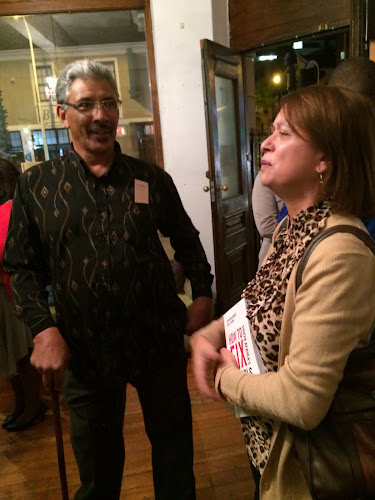
Ernest looking happy and relaxed after the event and he had no clue what had transpired earlier. Our country still has to travel a long road in terms of accommodating our people who have disabilities. I became aware of this yesterday when a group of us - a few of the school principals and I - attended Jonathan Jansen and Molly Blank's launch of their book, How to fix South African Schools, at the Book Lounge in Roeland Street, Cape Town. The place was packed to capacity, even the basement was overflowing with folk who wanted to hear the pair speak.   I spotted two of my colleagues, Bevil Velensky, the head of Kommetjie, and Nelson Mafrika, the head of Masiphumelele High school right at the back of the bookstore. They indicated that there was a vacant spot close to them and waved at me, urging me to join them. Now, being able-bodied, I wormed my way through the crowd, apologizing profusely and made sure that my arms and handbag did not become missiles in the process. Another guest...

Classroom libraries and other school business at Harmony Primary School

Image
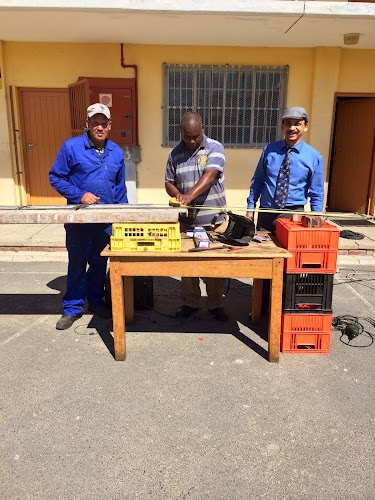
Ernst Esau (far right) standing with the welder and the school caretaker Impromptu visit to Harmony Primary School at the request of the Principal I visited Harmony Primary School today at the request of the principal, Ernst Esau. We had spoken on the telephone earlier and our conversation centred on Ernst's frustrations with their "plankie" school building and the high maintenance bill the school had to foot. Ernst has also been watching the renovations at other schools and our apparent disregard for their plight dominated our discussion. I listened patiently and offered advice as best I could. Then Ernst said, if I had time, could I please pop in at the school because he had a few documents he needed to process. I know our principals fairly well by now and I know the narratives behind such requests. It is the end of term one and the pace at schools is demanding. Throw in budgetary constraints, social issues, teacher fatigue and systems demands, and you know that you ha...

Social work services should be flipped to be in line with their core purpose

Image
Social workers have an educational role to play Social workers, like teachers, are supposed to be spearheading social change? Social workers working closely with our schools have the ideal platform to intervene proactively by integrating their services into the daily programme of school life. Let me explain where I am heading with this discussion by presenting a brief profile of the families and children who probably constitute 80% of a social worker's case load.   The sector that depends heavily on the support and intervention services of social workers is the poor, broken families. This group usually has multiple socio-economic and psychological problems that cause their lives to be unbearable. Because they do not have the knowledge nor the money to escape from this suffering, their future generations get stuck in this cycle as well.   If we want to help lift communities out of their poverty trap, the key driver is access to quality education. Research supports this view that e...

Eugene Daniels leaves a legacy for Education

Image
  A tribute to Eugene Daniels, Education District Director of Metro South There I was, an apprehensive novice education district official being spoken to by the Education District Director of Metro South Education District, Western Cape, Eugene Daniels. Eugene had joined us during our induction and enquired in a calm, warm voice how I was adjusting.  He looked just like one of us, except he had copies of the book “Leading in a culture of change” by Michael Fullan nestling on his table. Needless to say, by the end of the session, I went home armed with my personal copy of that book. I devoured every page and pencilled in key bits of information like a new student. Eugene at a Staff  forum held at Rondevlei Nature Reserve. Over the next four years, I experienced this MBWA-styled leadership embraced by Eugene. He was, as far as possible, part of our professional spaces. He joined us when we he ld professional development workshops for our educators, becoming a partici...